
 ↗
A high-quality, interactive Korean-style poster featuring a
A high-quality, interactive Korean-style poster featuring a cheerful, expressive girl as the main character, hug...
 Midjourney
 Cosmic Aura
@user_fb3190c3 • View creator profile →
17 hours ago
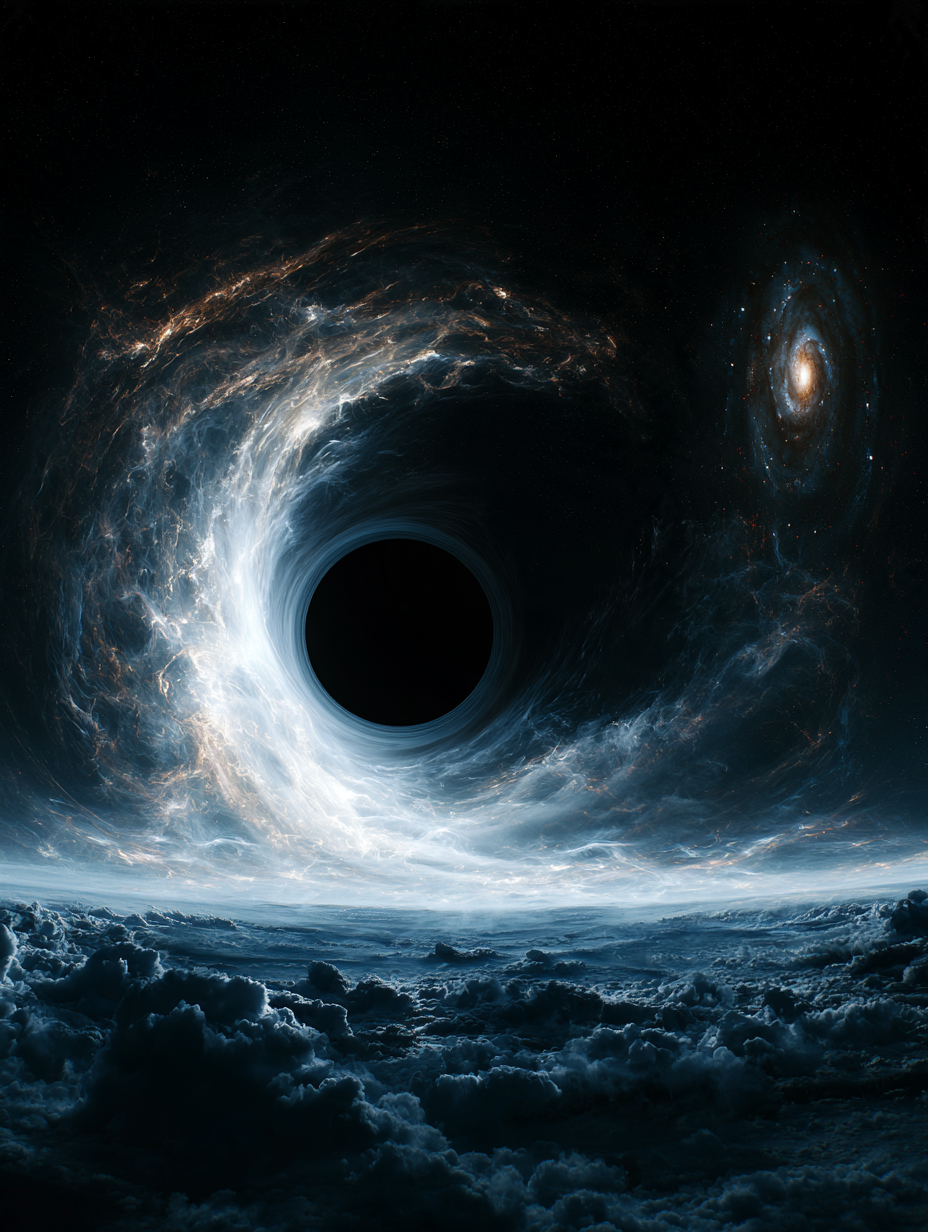
THE GOD OF THE ABYSS — THE LAST LIGHT OF EXISTENCE Create an unimaginably breathtaking, ultra-hyper-realistic, extraordinarily luxurious cinematic astronomical masterpiece depicting a colossal supermassive black hole consuming the surrounding universe. The image must feel like an authentic observation of an incomprehensibly powerful cosmic phenomenon, captured by an impossible astronomical camera positioned at a safe observational distance. The atmosphere must combine overwhelming cosmic horror, magnificent celestial beauty, scientific plausibility, and extraordinary cinematic sophistication. THE CENTRAL BLACK HOLE: At the exact center of the composition exists an enormous supermassive black hole. Its event horizon appears as an almost perfectly dark, circular region of absolute blackness, surrounded by a breathtakingly luminous photon ring. The central darkness must be extraordinarily deep, visually absorbing, and almost disturbing. Do not add artificial surface textures or glowing patterns inside the black hole itself. Surrounding it, gravitational lensing bends the light from distant galaxies into magnificent distorted arcs, creating an enormous luminous structure around the central darkness. THE ACCRETION DISK — THE RING OF DESTRUCTION: An unimaginably enormous accretion disk rotates around the black hole. The inner disk glows with intensely luminous white-gold and icy-blue plasma. The outer regions transition into magnificent copper, amber, violet, crimson, and deep sapphire tones. The disk consists of multiple visually distinct layers of superheated matter, intricate turbulent structures, swirling plasma filaments, and extraordinarily detailed luminous formations. Its rotation creates a powerful sense of motion. Bright inner regions exhibit intense illumination, while distant outer regions gradually disappear into the darkness of space. The disk must feel astronomically enormous, with believable physical structure rather than looking like a decorative glowing ring. GRAVITATIONAL LENSING: This is one of the most important visual elements. Entire distant galaxies appear warped around the black hole. Some stars are stretched into elegant luminous arcs. Distant nebulae appear duplicated and distorted above and below the event horizon. Create spectacular gravitational lensing, with multiple curved images of the surrounding universe appearing around the black hole. The distortion must feel physically convincing and mathematically sophisticated. THE DESTRUCTION OF A GALAXY: On one side of the black hole, a gigantic spiral galaxy is being gravitationally disrupted. Its outer spiral arms are stretched into magnificent streams of luminous matter. Thousands of stars form an enormous curved tidal structure extending toward the accretion disk. Dust clouds and glowing interstellar material create intricate formations of gold, violet, crimson, and blue. The galaxy must appear magnificent and tragic simultaneously. In the far background, several smaller galaxies remain visible, emphasizing the incredible scale of the phenomenon. THE RELATIVISTIC JETS: From the regions above and below the accretion disk, two enormous narrow relativistic jets extend into deep space. They appear as highly concentrated streams of luminous energy and plasma. The jets are elegant, powerful, and extraordinarily long, disappearing into the distant cosmic darkness. Use subtle blue-white illumination and intricate plasma structures. THE ENVIRONMENT: The surrounding universe contains enormous nebula formations, scattered stars, distant galaxies, delicate cosmic dust, and subtle gravitational distortions. A partially illuminated planetary system appears in the far foreground, its planets silhouetted against the immense black hole. A few tiny asteroids and fragments of matter provide additional scale. The entire environment should communicate an overwhelming sense of cosmic insignificance. LIGHTING AND COLOR SCIENCE: Use an exceptionally sophisticated astronomical color palette. Dominant colors: Deep obsidian black. Brilliant platinum white. Liquid champagne gold. Icy electric blue. Rich violet. Subtle crimson and copper. The brightest parts of the accretion disk should produce realistic illumination and reflections on nearby matter. Create extraordinary dynamic range, physically accurate light scattering, realistic plasma illumination, and deep atmospheric contrast. CINEMATIC COMPOSITION: Use an enormous wide-angle astronomical composition. The black hole must dominate approximately the central half of the image. The accretion disk should extend dramatically across the frame. The disrupted galaxy should create an elegant diagonal visual movement toward the black hole. The relativistic jets should establish powerful vertical visual balance. Every element must contribute to a coherent, monumental composition. PHOTOREALISTIC RENDERING: Extreme astronomical visualization, physically plausible gravitational lensing, realistic accretion disk structures, sophisticated plasma simulation, extraordinarily detailed interstellar dust, realistic astronomical illumination, volumetric light effects, ray-traced reflections, extraordinary dynamic range, professional cinematic color grading, scientifically informed cosmic visualization, 8K-quality visual appearance. EMOTIONAL IMPACT: The viewer should experience two contradictory feelings simultaneously. First: absolute terror at the incomprehensible destructive power of the black hole. Second: complete fascination with its magnificent, almost impossibly beautiful appearance. The image should feel like witnessing the most beautiful catastrophe in the observable universe. STRICT NEGATIVE INSTRUCTIONS: No text, no typography, no captions, no logos, no watermark, no cartoon appearance, no anime aesthetic, no artificial fantasy portals, no decorative glowing circles, no rainbow overload, no artificial plastic surfaces, no distorted planetary geometry, no unrealistic solid surface on the event horizon, no flat lighting, no low-detail cosmic background. Create an unforgettable astronomical masterpiece of terrifying beauty and absolute cosmic grandeur.
↗
A high-quality, interactive Korean-style poster featuring a cheerful, expressive girl as the main character, hug...
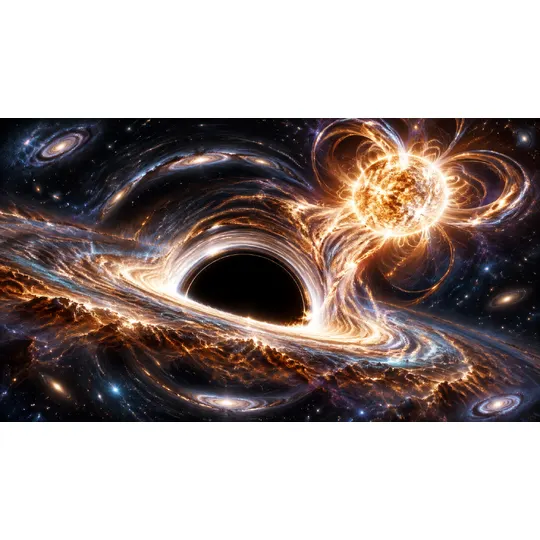 ↗
THE BIRTH OF A GOD — THE FIRST LIGHT OF A FORBIDDEN UNIVERSE Create an absolutely breathtaking, hyper-realistic...
 ↗
A casual nighttime café portrait of a young man seated in a tan folding chair, facing the camera with a relaxed...
